

 TH
TH JP
JP
Many organizations have experienced something like this:
Three years ago, adding a new feature took just three days.
Today, a similar feature takes three weeks.
What’s puzzling is that the team is larger, the tools are better, and everyone has far more experience than before.
So what happened?
The answer may not be that your team has become less productive. More often than not, the real culprit is something called Technical Debt, an invisible burden that many organizations carry without realizing it.
What Is Technical Debt?
In software development, the term technical debt is frequently used, yet often misunderstood.
Technical debt is not a financial liability, nor does it mean a company owes money to anyone.
Instead, it represents:
“A cost we intentionally create today to gain speed, knowing we will have to pay for it later.”
The concept was introduced by Ward Cunningham, one of the authors of the Agile Manifesto. He compared software development decisions to borrowing money: taking a shortcut today can help you move faster, but eventually the debt must be repaid.
This simple analogy became one of the most influential concepts in software engineering because it helps explain a common disconnect between business and technology teams:
Why does software that once worked perfectly eventually become a roadblock to innovation?
The Shortcut That Looks Cheap Today May Be the Most Expensive Choice Tomorrow
Imagine the business requests a new feature.
The engineering team estimates:
- Two weeks if built properly
- Three days if built using a shortcut
Faced with deadlines, customer demands, and competitive pressure, many organizations naturally choose the second option.
The feature ships quickly.
Customers are happy.
The business keeps moving forward.
Everyone wins.
At least, for now.
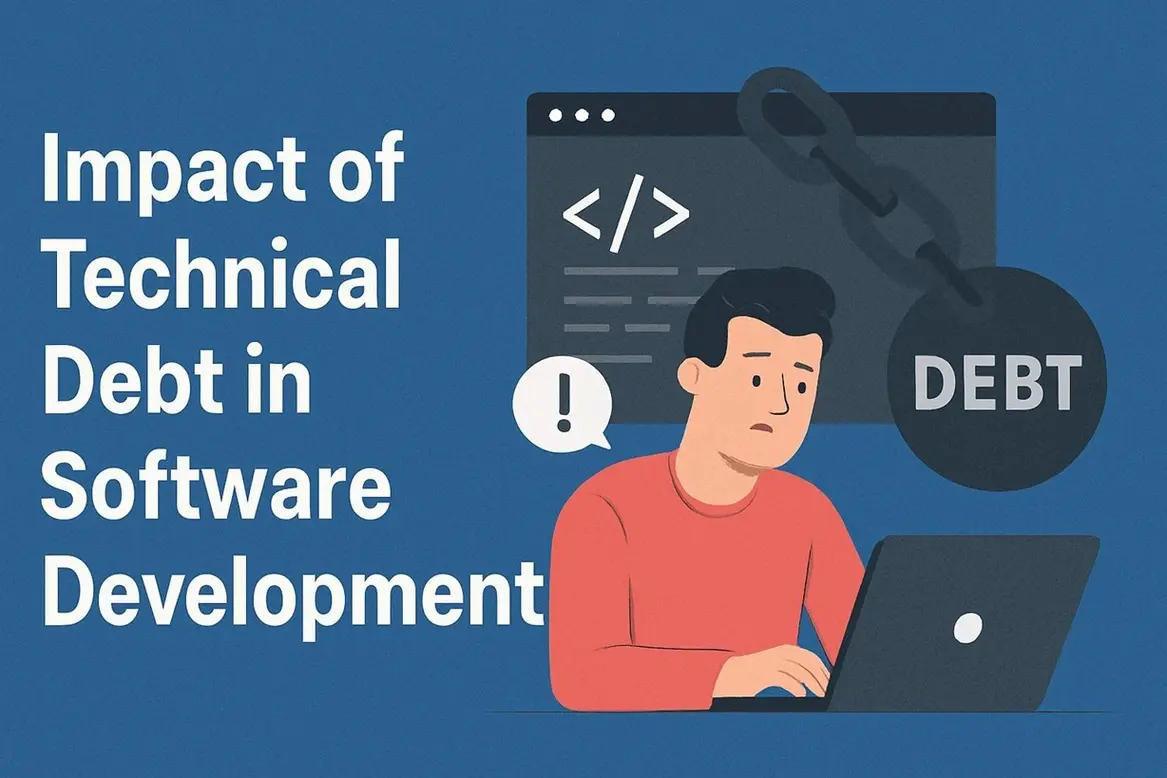
The problem is that today’s shortcut often becomes tomorrow’s obstacle. A feature that should take three days now takes five. The next one takes two weeks. Over time, the system becomes increasingly difficult to modify, and eventually even a minor change can take months. That growing burden is technical debt.
Technical Debt Isn’t Just About Bad Code
A common misconception is that technical debt simply means poorly written code or a large number of bugs.
In reality, it is much broader than that.
Technical debt can exist in virtually every layer of a technology stack:
- Code structure
- Software architecture
- Database design
- Infrastructure
- Testing
- Security
- Documentation
- Development processes
Consider a system built during a period of rapid business growth.
At the time, the primary goal was simple: “Get the system working.”
The team made pragmatic decisions to deliver value as quickly as possible.
Three years later, the business has grown. Customer demand has increased. More systems need to integrate. More data must be processed.
But the original architecture was never designed to handle that level of complexity.
Each new business requirement requires another workaround.
One system needs a connector. That connector needs another intermediary service. Then another layer is added to manage the first one.
Eventually, a once-simple platform turns into a maze that nobody wants to touch. The scary part is that this transformation doesn’t happen overnight. Technical debt accumulates slowly and quietly.
Why Is It Called “Debt”?
Because, like financial debt, it comes with interest. When you borrow money, you repay more than the principal. You also pay interest.
Technical debt works the same way.
- Principal = The shortcut you chose today.
- Interest = The extra time and effort required tomorrow.
Software expert Martin Fowler describes technical debt as the additional effort caused by design or implementation decisions that make future changes more expensive than they should be.
The longer the underlying problem remains unresolved, the more interest accumulates.
And unlike financial debt, many organizations don’t realize how much they’re paying until the costs become substantial.
Technical Debt Is Not Always the Villain
Interestingly, technical debt is not inherently bad. Sometimes it is a smart business decision.
Imagine a startup testing a completely new product idea. Spending months designing a perfect architecture before validating market demand may be a waste of resources.
In that situation, building a simpler solution and launching quickly can be the right strategy.
The problem is not creating debt but it is creating debt unknowingly and allowing it to grow unchecked. The most dangerous moment is not when a system becomes old. It’s when the system starts preventing the business from moving forward.
Warning Signs That Technical Debt Is Hurting Your Business
Your organization may be struggling with technical debt if you frequently notice these symptoms:
- New features take significantly longer than they used to.
- Developers often say, “We can’t change this without affecting several other systems.”
- Small modifications require extensive testing because nobody fully understands the impact.
- New team members need months to understand the system.
- Documentation is outdated, incomplete, or missing entirely.
- Critical knowledge is concentrated in one or two individuals.
- Every business request is answered with, “Yes, but…”
At this point, technical debt is no longer just an IT problem. It’s a business problem.
It slows time to market, increases operational costs, and reduces an organization’s ability to respond to changing market conditions.
When Should You Pay It Back?
The answer is not: “Fix everything immediately.”
No organization has unlimited time, budget, or resources.
A more practical approach is to understand:
- What debt exists
- Which debt is creating the most friction
- How much interest that debt is costing the business
Some messy code may never be touched again and therefore creates little business impact.
Refactoring it may provide minimal value. However, if there is a critical module that the business relies on every day and every enhancement triggers the same recurring problems, that debt should be a priority.
A simple rule is: Don’t pay off debt just because it’s debt. Pay off the debt with the highest interest rate.
Technical Debt Is a Business Issue, Not Just an Engineering Issue
When developers say: “We should refactor this system.”
Business leaders sometimes hear: “The IT team wants to spend time on work that doesn’t generate revenue.”
But from a technical debt perspective, refactoring isn’t about making the code look prettier.
It’s an investment. An investment in speed, agility, and reducing future costs.
If adding a feature once took three days but now takes three weeks, the company isn’t just losing time. It’s losing opportunities, responsiveness, and potentially, it’s losing competitive advantage.
Final Thoughts
The most important question about technical debt is not: “How long will it take to fix?”
The more important question is: “What will it cost us if we don’t?”
Because sometimes the most expensive part of software development isn’t building a new system.
It’s allowing the existing one to slowly make everything harder, slower, and more expensive.
Great software isn’t software with zero technical debt.
Great software is software where the organization understands what debt it has, which debt is worth taking, which debt must be repaid, and which debt could become dangerous if ignored for too long.
Technical debt may never appear on a balance sheet. But sooner or later, it will show up in your costs, your delivery speed, and your ability to compete.
And when that day comes, the question may no longer be:
“How much technical debt do we have?”
But rather:
“How long have we been letting it accumulate?”

