

 TH
TH JP
JP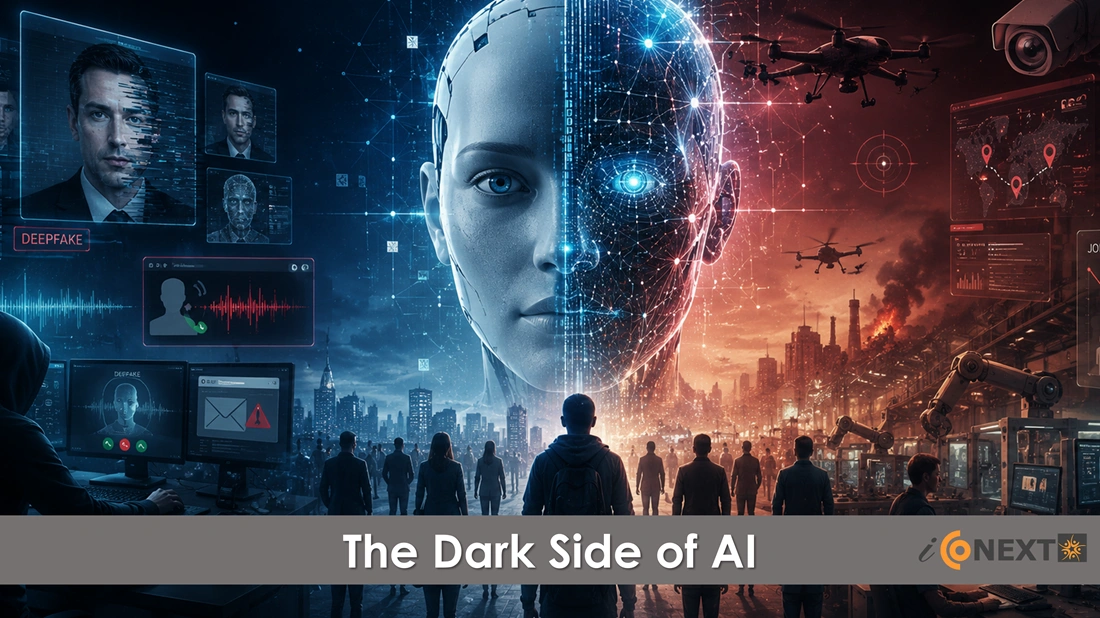
When people think about the dangers of artificial intelligence (AI), the first image that often comes to mind is a killer robot from a Hollywood movie. In reality, however, the threat of AI is unlikely to come in the form of machines rising up against humanity. Instead, it arrives in ways that are quieter, more subtle, and deeply embedded in our daily lives, often without us realizing it.
AI is already becoming part of our everyday lives. It appears in fake videos that are almost indistinguishable from reality and in scam calls that perfectly imitate the voices of family members or friends.
Its influence extends far beyond these examples. Certain jobs are gradually disappearing, while AI-powered systems increasingly make decisions that affect our lives using data we may never see or fully understand.
As AI continues to evolve, it is quietly reshaping the world around us in ways many people may not even notice.
This article explores the darker side of AI that is already emerging today.
It also examines the risks that may become even more significant in the years ahead.
The goal is not to create fear, but to encourage awareness, understanding, and preparedness in a rapidly changing world. The goal is not to create fear, but to encourage awareness, understanding, and preparedness as technology evolves faster than laws, social norms, and public understanding can keep up.
1. Deepfakes and the Erosion of Truth
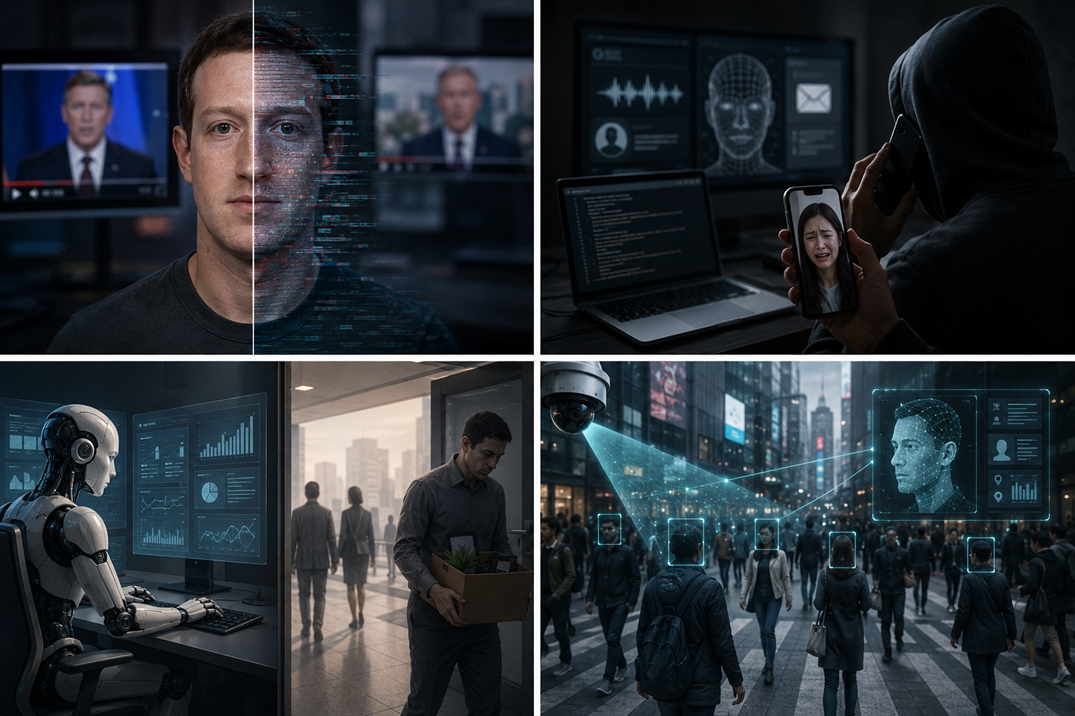
One of the most tangible AI-related threats today is deepfake technology. It can generate images, voices, and videos that appear remarkably realistic. In many cases, these AI-generated creations are nearly impossible to distinguish from authentic content.
In the past, creating convincing manipulated videos required teams of experts and significant resources. Today, AI tools have dramatically lowered both the cost and technical barriers to content creation. As a result, creating highly realistic fake content has become much easier than before.
The concern is not only that people may believe fake content. More troubling is the possibility that people may stop believing genuine content altogether. If anyone can claim, “That was generated by AI,” the credibility of digital evidence itself may begin to erode, even when the evidence is authentic.
2. The New Era of Cybercrime: Smarter Scams Every Day
AI has dramatically increased the effectiveness of fraud and deception.
Call center scams once relied on scripted conversations and generic tactics. Today, many criminals are using AI tools that can clone a person’s voice from just a few seconds of recorded audio. This allows scammers to imitate a victim’s family member, friend, or acquaintance with alarming accuracy. Criminals can then place convincing calls, pretending to be someone the victim knows and trusts.
Phishing emails have evolved as well. Messages that were once easy to identify because of awkward grammar and spelling mistakes can now be written in fluent, professional language. AI can personalize these messages for individual targets and generate them at scale.
At the corporate level, there have already been reported cases of employees being tricked into transferring large sums of money through video calls involving deepfake technology.
In some instances, scammers used AI-generated faces and voices to impersonate trusted colleagues or executives. These incidents highlight a troubling reality. Seeing a face and hearing a familiar voice in real time may no longer be enough to verify someone’s identity.
As AI tools become cheaper and easier to use, such crimes are likely to become more widespread, while defenders will continue struggling to keep pace.
3. The Disappearing Job Market
The fear that machines will replace human workers is not new. What makes AI different is that it is not limited to replacing physical labor. It is increasingly capable of performing knowledge-based and creative work that many once assumed was safe from automation.
Writing, translation, graphic design, entry-level programming, accounting, customer service, and data analysis are just a few examples of occupations being affected.
Many organizations have already begun slowing recruitment for entry-level positions because AI can complete portions of these tasks at a significantly lower cost.
The deeper issue goes beyond job losses. The real question may not be:
“Will AI take our jobs?”
but rather:
“If AI takes entry-level jobs, how will future professionals gain the experience needed to become experts?”
Furthermore, the economic benefits generated by AI are likely to concentrate among a relatively small number of large technology companies, potentially widening existing income and opportunity gaps.
4. The Surveillance Society: When Privacy Becomes a Luxury
AI has made large-scale surveillance both practical and affordable.
Connected surveillance cameras equipped with facial recognition technology can potentially track individuals across entire cities in real time. Internet activity, location history, purchasing behavior, and countless other forms of personal data can be processed to build detailed profiles that may know us better than we know ourselves.
In the hands of governments without sufficient oversight, these technologies can become tools for monitoring and controlling citizens on an unprecedented scale.
In the private sector, AI systems can analyze massive amounts of information to predict our interests, preferences, and behaviors with increasing accuracy.
What makes this particularly concerning is that much of this process happens quietly in the background, often designed in ways that make us feel as though our decisions are entirely our own.
5. When AI Makes Life Too Easy
Not all AI-related risks come from malicious intent. Some emerge from convenience itself.
AI can answer questions, write documents, generate ideas, and even provide companionship at any hour of the day. While these capabilities offer tremendous benefits, they also raise important questions.
What happens to critical thinking, writing skills, creativity, and human interaction when AI consistently performs these tasks for us?
There is growing concern about people relying on AI chatbots as substitutes for human relationships, particularly among children and young people who are still developing social skills. Unlike real relationships, AI systems are often designed to be agreeable, accommodating, and conflict-free.
The danger may not appear immediately. Instead, it may emerge gradually as people stop practicing essential human skills because AI is always available to handle them. Over time, we may lose not only certain job-related abilities, but also aspects of our capacity for independent thinking and decision-making.
6. Autonomous Weapons and the Race No One Wants to Lose
AI is increasingly being integrated into military systems and target-analysis technologies.
The critical question is no longer whether AI can identify potential targets, but how much decision-making authority humans should be willing to delegate to autonomous systems when human lives are at stake.
Beyond military applications, the global race to develop more advanced AI systems continues to intensify. Governments and major technology companies face strong incentives to move quickly because no one wants to fall behind competitors.
Such competition can create an environment where safety and careful evaluation become secondary priorities.
Many leading researchers have warned about the risks associated with advanced AI systems. Some of these experts are directly involved in developing AI technologies themselves. Their concern is that AI systems are becoming increasingly capable and complex. At the same time, humans do not yet fully understand how these systems work or how to control them. As a result, the potential risks should not be underestimated.
What Should We Do?
All of the risks discussed above do not mean that we should reject AI. In fact, the same technology is already delivering tremendous benefits in many areas, such as accelerating the discovery of new medicines, improving education, automating certain tasks, and helping us solve problems that might otherwise take significant time and effort to understand or answer.
What we can do instead is build our own “digital resilience“. This starts with maintaining a healthy level of skepticism toward images, audio recordings, and videos that provoke strong emotional reactions. It also means verifying information through multiple sources before believing or sharing it. Families can establish verification codes or safe words to confirm identities during emergencies.
In addition, we should continue developing skills that AI cannot easily replace.
These include specialized expertise and uniquely human abilities such as negotiation, relationship-building, empathy, and strategic decision-making.
At the societal level, we need to advocate for laws and governance frameworks that can keep pace with technological advancements. These should include requirements to clearly identify AI-generated content, accountability mechanisms for developers and organizations when AI causes harm, transparency in algorithms that influence people’s lives and opportunities, and support systems for those negatively affected by technological disruption. International cooperation is also essential, particularly on issues such as autonomous weapons, where no single country can effectively address the risks alone.
Conclusion
The real danger of AI is not that machines will rise up against humanity.
The greater risk is that powerful technologies will be deployed faster than our ability to understand, regulate, and responsibly manage them.
AI has the potential to reshape truth, security, employment, privacy, and society itself. The challenge is not to stop AI, but to ensure it is developed and used responsibly.
Ultimately, the future of AI will not be determined by technology alone.
It will be determined by the choices we make today.

