

 TH
TH JP
JP
In today’s data‑driven era, information has become the core driver of business operations. Ensuring data accuracy and consistency is therefore critical. This is especially true in accounting and finance, where even minor discrepancies can lead to significant business errors and directly impact an organization’s credibility.
Reconciliation plays a vital role in verifying, comparing, and aligning data from multiple systems and sources. It is a fundamental process commonly found in various areas, such as:
- Bank Reconciliation
- AR / AP Reconciliation
- GL Reconciliation
Although reconciliation is essential and unavoidable, it is also time-consuming and requires a high level of precision. As data volumes grow, traditional manual processes that rely heavily on visual checks can increase the risk of errors more than expected.
Objectives of Reconciliation
Reconciliation is not just about “checking numbers.” It is a process that enhances the accuracy and efficiency of an organization’s overall operations. Its key objectives include:
1. Ensuring Data Accuracy
Verify account balances and system data, reducing human errors such as incorrect entries or missing information.
2. Ensuring Data Consistency Across Multiple Sources
Align data from different systems, such as accounting systems and bank statements, ensuring consistency and traceability.
3. Identifying Discrepancies
Detect differences such as timing differences, duplicate entries, missing transactions, or unusual expenses.
4. Correcting and Updating Data
Make adjustments to ensure data is accurate, up-to-date, and reflects actual transactions.
5. Improving Business Processes
Identify process pain points, optimize workflows, and lay the foundation for future automation.
Transforming Reconciliation with RPA and AI-OCR
Traditionally, reconciliation required significant manual effort, involving document review and line‑by‑line data comparison. Today, technologies like RPA (Robotic Process Automation) and AI-OCR (AI-powered Optical Character Recognition) are transforming these processes into fast, accurate, and scalable automated workflows.
Example 1: Automated Invoice Reconciliation
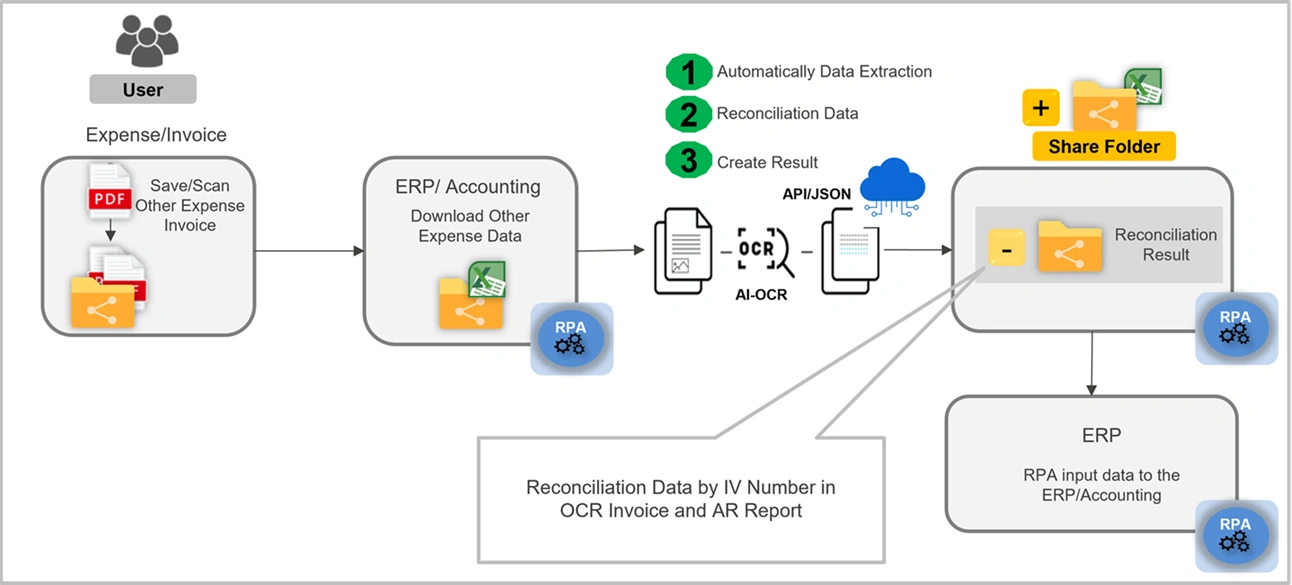
Verifying invoices against expense data traditionally requires significant time and attention to detail. Staff must review each document individually, compare figures, and manually enter data into multiple systems. This makes the process both time consuming and prone to errors.
By combining RPA and AI-OCR, this entire workflow can be automated:
- Automatic Invoice Reading
AI-OCR extracts key data such as invoice numbers, dates, amounts, and details quickly and accurately without manual input. - Automated Data Matching
RPA compares extracted data with accounting or expense systems, instantly identifying mismatches or anomalies. - Structured Reconciliation Reporting
The system generates reports highlighting matched items, discrepancies, and items requiring further review. - Automatic Data Entry
Once verified, RPA records accurate data directly into accounting or ERP systems, eliminating repetitive manual tasks.
As a result, tasks that once took hours can now be completed in minutes, with significantly reduced errors.
Example 2: Automated Bank Statement Reconciliation
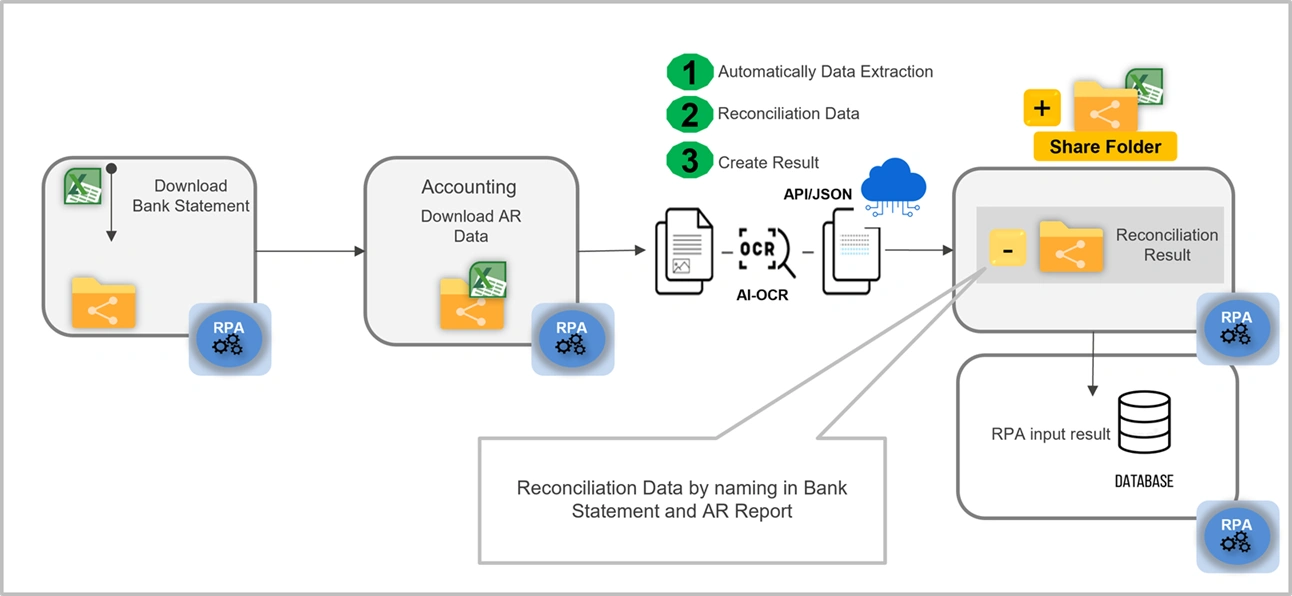
Bank reconciliation is another critical process that requires a high level of accuracy, especially for organizations with large transaction volumes. Manual daily verification of cash inflows and outflows can be both time consuming and prone to errors.
With RPA and AI-OCR, the process becomes fully automated:
- Automatic Data Extraction from Bank Statements
Whether the files are in PDF, Excel, or received directly from the bank system, AI‑OCR and RPA can read and capture all transaction data in real time. This eliminates the need to download files or enter information manually. - Accurate Matching with AR Data
The system automatically matches bank data with accounts receivable, checking the consistency of payment amounts, dates, and transaction details. - Clear Transaction Status Visibility
The system can immediately identify which transactions are “paid” and “unpaid,” as well as highlight items that require further review. This helps reduce the burden of checking each record manually. - Cash Flow Monitoring Against Financial Plans
It analyzes whether cash flow is aligned with the planned targets and issue alerts when irregularities or discrepancies require attention.
Organizations can perform reconciliation daily or even multiple times per day. This helps improve cash‑flow visibility and accuracy significantly.
Why RPA and AI-OCR Are the Future of Reconciliation
✔ Reduce Repetitive Work
RPA automates routine tasks such as data extraction, matching, and reporting, allowing teams to focus on higher-value analysis.
✔ Minimize Human Error
AI-OCR accurately captures data from documents, reducing input errors and improving data reliability.
✔ Increase Speed and Accuracy
The automated system can process large volumes of data within minutes. It also performs real‑time accuracy checks, enabling faster and more efficient account closing and transaction verification.
✔ Lower Long-Term Costs
Although the initial implementation may require system investment, in the long term the organization will clearly reduce labor costs, shorten processing time, and lower expenses resulting from errors.
✔ Enable End-to-End Automation
Implementing RPA and AI‑OCR for reconciliation is only the beginning. Organizations can further expand automation into many other processes, such as document management, approval workflows, and advanced data analytics.
Organizations that adopt automated reconciliation gain a strategic advantage. This is not only in data quality and operational speed, but also in scalability, adaptability, and long-term competitiveness in the digital era.
iCONEXT is Your Partner in RPA and AI-OCR Solutions
With a team of experts in RPA and AI‑OCR technologies, iCONEXT is ready to help design and implement automated reconciliation solutions tailored to your business needs. This enhances efficiency, reduces costs, and enables your team to focus on higher‑value work.
Click here to download RPA brochure
Click here to download AI-OCR brochure
For more information, please contact us at thaisales@iconext.co.th or fill out the Inquiry Form to have our team reach out to you.

