

 TH
TH JP
JP
In the technology landscape of 2026, we are no longer in an era that requires us to choose between classical computing and quantum computing. Instead, we are entering a new phase known as hybrid computing, an advanced approach to computation that intelligently brings together the strengths of both paradigms to work in harmony.
Hybrid computing is not merely a fashionable term within research communities. It is rapidly becoming a central driver of global innovation, with applications spanning artificial intelligence, healthcare, finance, energy, and materials science.
At its core, it acts as a bridge between what computers already do well and what humanity has never been able to calculate before. It unlocks new possibilities for solving problems once thought to be beyond reach.
What Is Hybrid Computing?
Hybrid computing is a system design concept that integrates the computational power of two complementary approaches:
- Classical Computing
Conventional computing systems we are familiar with, ranging from servers and cloud platforms to supercomputers and high performance GPUs. - Quantum Computing
Computing systems that leverage principles of quantum physics, such as superposition and entanglement, to solve extremely complex problems. They are designed to solve extremely complex problems that are beyond the practical reach of classical computers.
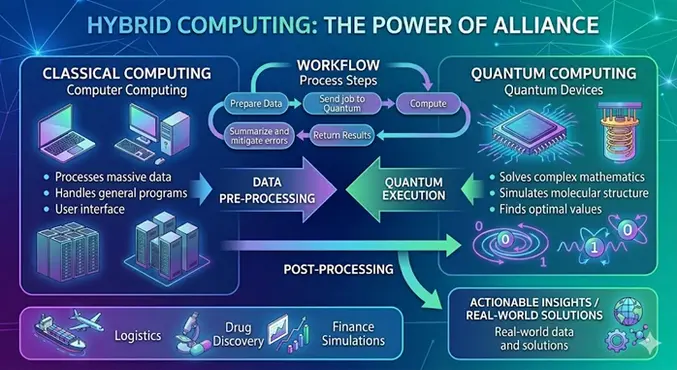
To illustrate this more clearly, consider the following comparison:
- Classical Computing
Classical computing can be likened to a professional manager who is both versatile and dependable. First, it excels at handling large scale data with reliability. In addition, it is highly effective at organizing workflows and coordinating complex processes. As a result, it performs general purpose computations with a high level of stability and consistency across a wide range of tasks. - Quantum Computing
In contrast, quantum computing is comparable to a highly specialized mathematical prodigy. Rather than focusing on routine or day to day tasks, it is designed for a very different purpose. Specifically, it can solve problems of extraordinary complexity. These are problems that would require classical computers thousands or even tens of thousands of years to process. Consequently, quantum computing is able to achieve results in an astonishingly short amount of time.
Hybrid computing is therefore not about replacement. It is about strategic pairing, allowing each technology to focus on what it does best.
Why Hybrid Computing Has Become the Answer for This Era
Despite the immense potential of quantum computing, real world adoption today still faces several critical limitations.
These challenges include environmental noise that interferes with quantum signals, the inherent instability of qubits, and constraints related to the number of available qubits and the duration of reliable computation time.
Because of these factors, running large scale and long duration programs exclusively on quantum systems remains impractical at present.
As a result, hybrid computing has emerged as a practical and strategic solution. It is built on a key principle best described as dividing the work to achieve the best possible outcome, allowing each computing paradigm to contribute where it is strongest.
How Hybrid Computing Works
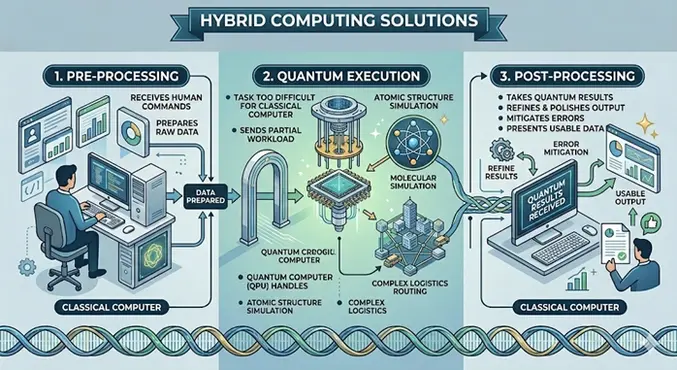
The operation of a hybrid computing system can be summarized into three core stages that flow together seamlessly.
1. Data Preparation (Pre processing)
Classical computers are responsible for receiving instructions from humans or AI systems and preparing the data. This stage typically involves:
- Cleaning the data
- Structuring the data appropriately
- Selecting only the portions that are suitable for quantum computation
2. Advanced Computation (Quantum Execution)
Only tasks that are too complex for classical computers are sent to the Quantum Processing Unit (QPU). Examples include:
- Simulation of atomic and molecular structures
- Large scale optimization problems
- Parallel computation of massive numbers of possible outcomes
3. Result Processing and Error Reduction (Post processing)
Once the quantum system returns its results:
- Classical computers validate and verify the outputs
- Noise effects are reduced and computational errors are mitigated
- Results are analyzed, interpreted, and transformed into insights that can be applied in real world business and operational contexts
This coordinated workflow allows hybrid computing systems to balance practicality with advanced computational power.
Real World Use Cases Transforming the World in 2026
- Biotech and Pharmaceutical Industry
In drug discovery and life sciences, AI running on classical computing systems is used to screen millions of molecular candidates. Quantum computing is then applied to simulate atomic level interactions, enabling the discovery of new drugs with far greater precision while dramatically reducing research and experimental costs. - Intelligent Finance (Quantum Finance)
Financial institutions leverage hybrid computing systems to calculate portfolio risk across thousands of highly complex variables. This approach enables real time risk assessment and uncovers hidden patterns of fraud that traditional AI systems alone are unable to detect. - Energy Industry
Hybrid computing plays a critical role in designing next generation battery materials capable of storing up to ten times more energy than current solutions. Quantum computing is used to simulate material structures, while AI analyzes performance outcomes. Together, they accelerate the development of clean energy materials and technologies that significantly reduce environmental impact.
Hybrid Computing and the Next Step of Humanity
The arrival of hybrid computing is not merely about increasing computational speed. Rather, it represents the opening of a gateway to new possibilities for humanity. Problems that were once believed to require tens of thousands of years of computation may now be solved in just minutes or hours.
In the near future, we will see continued growth in Quantum as a Service delivered through cloud platforms. This shift will turn hybrid computing into a foundational tool. Developers, researchers, and organizations around the world will be able to access quantum capabilities through hybrid systems without the need for massive investments in specialized infrastructure.
Conclusion
Hybrid computing demonstrates that the future of technology does not lie in replacement, but in intelligent collaboration.
When AI, classical computing, and quantum computing work together, what was once confined to science fiction is gradually becoming a reality. These capabilities can now be built, applied, and expanded upon starting today.

